Wednesday, June 26, 2013

Star Trek- Vulcans Need Not Apply

These are the voyages of the Blogship No Spoiler Tags. It's two year mission to seek out Star Trek. New episodes and movies. To boldly go where I've pretty much already been before.

Translation: I recently finished watching Star Trek, every movie, every episode, every series, even though I've pretty much seen all of them before. It has taken me more than two years.

During this quest through hundreds of hours of Starfleet footage, a disturbing trend of racial discrimination has emerged. Starfleet, a supposed meritocracy, has, for more than a century and across at least two universes, engaged in favoritism in the hiring and promotion of humans at the expense of non-human races, typically Vulcans. Some of the most egregious examples of discrimination occurred in J. J. Abrams' Star Trek. But first, a discussion about time travel.

In Star Trek: First Contact, the Borg travel through time to prevent Zefram Cochran from breaking the warp barrier. They damage the Phoenix and during the repairs Geordi discovers that the ship was flawed an incapable of breaking the warp barrier. With the help of the Enterprise, the Phoenix makes it's fateful voyage and the Federation is born. Thus, by trying to prevent the first warp flight by humans, the Borg actually made it happen. This is known as the Picard Paradox. I now offer the Abrams Addendum. Following Nero's intervention, including the destruction of Vulcan, Picard's Enterprise could not exist in the Abrams universe; however, the Abrams universe could not exist unless Picard had traveled through time to help Zefram Cochran.

Now, a musical interlude. This one goes out to you, J. J....
 

Back to racism.

When Captain Pike first meets Jim Kirk, he has just finished sexually harassing one cadet and starting a fight with five others. Pike immediately says he could be a Starfleet officer in four years and a captain in eight. Three years later, Cadet Kirk is about to be expelled from Starfleet Academy for an act of academic dishonesty. Meanwhile, Commander Spock is already a distinguished officer. Cadet Kirk then proceeds to stowaway on a Starfleet vessel during a crisis situation. He is put off the ship for gross insubordination. He then illegally boards the Enterprise for a second time and commits an act of mutiny. Following the resolution of the Nero crisis, Cadet Kirk is promoted to captain and retains command of the most advanced vessel in Starfleet. This promotion bypasses hundreds of non-human candidates, including Commander Spock, with better qualifications, more experience and far better disciplinary records.

Jumping over to the other universe, we find an Enterprise with a crew compliment of over 400. Despite the fact that the Federation consists of numerous worlds, the Enterprise has a non-human component of one-half. (That's half a person, not half the crew.) This crewmember must endure constant ridicule and racial slurs from his shipmates. This flagrant racism is made even worse by the fact that his captain is frequently the instigator of these acts of discrimination.

Moving ahead about 75 years, we find that the situation has improved slightly, but Starfleet is still over 50% human. Many of the races in the Federation, including Vulcans, are much longer lived than humans, so assuming Starfleet is a meritocracy the higher ranks should be filled with non-human races; however, the reality is that the vast majority of the personnel ranked commander and above are human. Some case studies in discrimination:
  • Lt. Commander Dax, a Trill, has nearly 400 years worth of experience; however, she is forced to serve as third in command on a remote space station. She is demoted at least twice for no other reason than advancing in her natural life cycle. These advancements in her life cycle make her no less capable of performing her duties, in fact, they vastly increase her overall experience. She currently serves under a human who was her subordinate officer during a previous phase of her life cycle.
  • A Vulcan captain, in hopes of proving the worthiness of his race, assembles an all Vulcan crew. During the Dominion War, this segregated crew is constantly given the most dangerous assignments.
  • Starfleet approves the vivisection of an Android officer against his will and ignoring potential long-term medical consequences. Approval is made on the grounds that the officer is not a person and the property of Starfleet.
  • Lt. Commander Tuvak, a Vulcan, has about 75 years of experience in Starfleet. He has been repeatedly sited for his exemplary service, but he has not risen above third officer on a minor vessel. Following the death of the ship's second officer (a human), Commander Hasonelineinthepilot, Lt. Commander Tuvak is the natural fit to replace him given his current position and the lack of available replacement personal. However, the promotion goes instead to a human, a human with no official rank in Starfleet who is currently wanted for treason. After five years on the ship a human officer, Ensign Kim, laments that the ship's situation has robbed him of any promotion opportunities while those he graduated with from Starfleet Academy are now beginning to reach lieutenant commander. So, a human officer expects to achieve a rank in five years which a Vulcan cannot move past in seventy-five.
Luckily, we have had laws like the Voting Rights Act to prevent such discrimination.

Monday, June 10, 2013

Das Boot- A Viewer's Log

6:30 PM: As I prepare to embark on this journey through Das Boot, I am filled with trepidation. Never one to back down from a challenge, I am taking on the Director's Cut with a full hour of additional footage. (Because how could you possibly tell a story in a mere two and a half hours.) This voyage will take me past 10PM isolated from every word of English I know and love. Will I survive? And if I do will I still be the same man? Probably, I'm just watching a movie.

6:33PM: Very few films a bold enough to begin with a golden shower.

6:45PM: An indiscriminate shooting. Finally, something an American audience can relate to.

6:50PM: We get a tour of the ship. It's nice, but I was really hoping for something with a larger kitchen. We're going to move on to the next place on the list. Oh, this is the only place available. There sure are a lot of roommates. Strange, too. Do they always pile on top of each other like that?

7:00PM: Have irrepressible urge for ice cream. Pause film.

7:10PM: Our first contact with the enemy. Let's sink those English swine.

7:11PM: Hey wait a minute, these guys are Nazi bastards. Kill 'em all.

7:14PM: No, don't hurt these brave soldiers of the glorious Fatherland, you limey bitches.

7:20PM: Begin to wonder if I will put any music in this post. Realize I know four songs with submarine in the title. Seems high for such an esoteric object. Decide that The Lumineers have the most appropriate song. First song from this century used on No Spoiler Tags. Also first local music.

7:30PM: This movie is riveting. As in there are rivets flying through the air trying to kill everyone. Also it's suspenseful and compelling.

7:40PM: We are getting very familiar with the crew of this sub. Begin to think that the purpose of this film is to humanize people we traditionally consider the enemy. Maybe not everyone who fights on the other side of a war is evil. Maybe some of them are just people defending their homes. Maybe some of them don't even agree with their country's leadership. Nah, too crazy.

8:10PM: Phone rings. Pause film. It's a survey about movies. Hang up. Like I'm going to give my opinions about movies to strangers.

8:20PM: Burn the crew of a merchant ship to death. (Fucking Nazi bastards.)  Feel really sorry about it.

8:40PM: We are really getting tossed around by this storm. Why don't we dive to get underneath it?

8:42PM: We dive to get underneath it.

8:50PM: Lots of German sailor ass. Endearing German sailor ass.

8:55PM: Assholes at headquarters order us through the Strait of Gibraltar. This won't go well.

9:10PM: This isn't going well.

9:15PM: KABOOM! Surround sound is awesome.

9:20PM: Um-Ba-Ba-Bay.

9:25PM: Torrents of rushing water. Pause film. Torrents of rushing water.

9:30PM: Finally, we get to watch those Nazis drown like the fucking rats they are.

9:40PM: What? They aren't going to drown. Good drowning too quick for them. Let's see them asphyxiate knowing they are helpless to save themselves.

9:55PM: Yes, those noble men of the U-92 are getting off the ocean floor. They are a true inspiration to all of Germany.

9:59PM: And they will evade the English. Yes, they will make it back to port.

10:00PM: Swastikas and Gothic lettering. Hey, I think those guys speaking German riding a U-boat are Nazis. Fuck those guys.

10:02PM: The RAF fucks those guys.

10:05PM: The crew thinking they had reached safety after months of constant danger are now dying. And as the captain takes his last breath, watching the conning tower of his beloved ship which he and his crew had fought so hard to raise from its presumptive watery grave submerge for the last time into what was believed to be a safe harbor, we are reminded of the futility of war.

Sunday, May 19, 2013

Star Trek Into Darkness- I Feel Khaaaaaaaaaaaaaaaaan'd

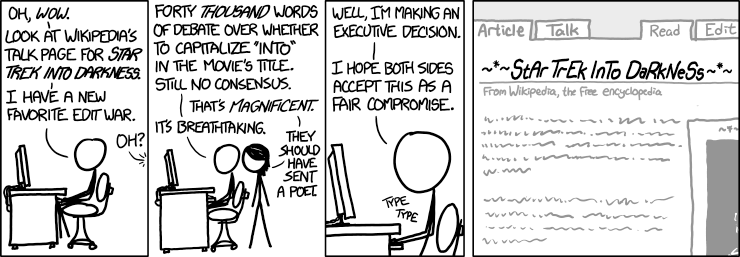
Recently something incredible has come to Denver. It is called the Alamo Drafthouse and it is the best way to watch a movie short of a Hollywood premiere. Alamo Drafthouse has been operating for decades in Austin, but recently they have been branching out across the country. If you've got one near you, you owe it to yourself to go. They serve food and drink in the theater, they have a very strict "No talking" policy, and show strange, obscure and relevant clips before the film. But what makes the Alamo Drafthouse really amazing are the special events they do on a regular basis. The last two times I went to the Drafthouse I saw comedic versions of Star Trek II: The Wrath of Khan. The first time it was with live MST3K-style commentary by the very funny guys of Mile-Hi Sci-Fi. More recently I saw ~*~StAr TrEk InTo DaRkNeSs~*~.

The movie's title is derived from the 50% of the screen which was not covered in lens flare. J.J. Abrams is known for his "distinctive" directorial style where buries the film under this annoying effect which modern cameras were specifically made to prevent because no one wants to see it. So it's great to hear that Abrams is attached to direct the next installment of an iconic sci-fi franchise, where the characters swing around blades made of light.

The opening sequence of the movie leads to Spock fighting with Kirk about violating Starfleet General Order Number 1, better known as the Prime Directive which states:
As the right of each sentient species to live in accordance with its normal cultural evolution is considered sacred, no Star Fleet personnel may interfere with the normal and healthy development of alien life and culture. Such interference includes introducing superior knowledge, strength, or technology to a world whose society is incapable of handling such advantages wisely. Star Fleet personnel may not violate this Prime Directive, even to save their lives and/or their ship, unless they are acting to right an earlier violation or an accidental contamination of said culture. This directive takes precedence over any and all other considerations, and carries with it the highest moral obligation.
In this sequence, Spock uses super-advanced technology to prevent the extinction of a species, but Kirk allows the native population a brief glimpse of the Enterprise. So according to Spock's detailed legalistic mind, saving a species from extinction in a natural disaster equals non-interference, but a UFO sighting (which have always been treated with credibility and respect here on Earth) is a grave violation of all that Starfleet stands for.

The problems with star TREK into DARKNESS really began when the Enterprise got to Kronos. In the original series, Klingons looked a lot like Vulcans with mustaches. When the movies came out, Klingons got their Worf-esque make-over. Then the series Enterprise had a storyline where the Klingons were infected by a virus which cleared up the inconsistency, it was a stupid explanation, it had to be, but it resolved the problem. When Klingons appeared in Star Trek Into Darkness, they were wearing masks, a brilliant compromise, and then one of the Klingons removed his mask. The face behind the mask was not the Vulcan-esque vestige from the original series, which would have fit best with the series timeline, nor did we see the later Worfish appearance, but a third face we have not seen before. This implies that time-traveling Romulans can incidentally change the genetic traits of an entire species. Furthermore, we find out that the Romulans race altering powers can reach back in time about 200 years before the point they traveled back to magically transforming Khaaaaaaaaaaaaaaaaaaaaaaaaaaaaaaaaaaaaaaaaaaaaaaaaaaaaaaaaaaan from Indian to white.

At the end of Star Trek, Old Spock told Young Spock that the world was different now and that they would experience a whole new set of adventures. J.J. Abrams wasn't listening. Because once Khaaaaaaaaaaaaaaaaaaaaaaaaaaaan joins the cast, the movie became a series of increasingly annoying, obvious, and unwelcome homages to Wrath of Khan with Kirk taking Spock's place of climbing into the reactor and then having the same dying conversation in reverse. By the time, Spock yells "Khaaaaaaaaaaaaaaaaaaaaaan" I was dreading Star Trek III: The Search for Kirk. (Kirk came back to life because Khaaaaaaaaaaaaaaaaaaaaaaaaaaaaaaaaaaaaaaaaaaaaaaaaaaaaaan is Wolverine now, too.)

Khaaaaaaaaaaaaaaaaaaaaaaaaaaaaaaaaaaan, the super-genius who defeated thousands of other super-geniuses, to conquer a third of Asia during the Eugenics Wars was beaten by a move out of the Bugs Bunny playbook. 
Khan: Give me the torpedoes. 
Spock: *Snicker* Please, don't hurt us in our severely crippled vessel with your superior ship in perfect working order. *Chuckle* We'll give you the torpedoes. *Giggle*
[Spock beams over the torpedoes which immediately blow up and destroy Khan's ship.]

There is one bit of inconsistency introduced in STar TRek INto DArkNEss that I actually like. Finally, after the death of thousands of crewmembers, Starfleet has installed seatbelts on one of its ships. Now, if they would just stop putting explosives in all their consoles.

Saturday, February 2, 2013

Strangers on a Train- The Surgeon General Warns That Smoking May Be Hazardous To Your Health

Can I bum a smoke? Care for a light? Would you like a cigarette? These may be the most dangerous questions in cinematic history. Hundreds have died (fictionally) from smoking related causes, not from cancer like actual people die from but from the conversations which begin with the socializing aspects of smoking. Case exemplar: Strangers on a Train.

When Bruno meets Guy, he is quick to offer a cigarette and Guy replies by pulling out his lighter. And Bruno uses the lettering on the lighter to steer the conversation towards murder. Bruno flicks a light before strangling Miriam. And the key piece of evidence that Guy can't let Bruno plant, leading to the death of no less than two more people (including Bruno): that same monogrammed lighter.

Of course deadly smoking is not limited to Strangers on a Train, it was a staple of film noir. When the fem fatal entered the private dick's office, she would always have a cigarette at the end of a long holder. Why? What made smoking so key to these films?

Well, for one thing, "Hey, buddy, got a light?" is a great way to start a conversation with a total stranger. There really is nothing like it since smoking has fallen out of style. Lighting a smoke for a lady has given many a fictional man an excuse to chat her up and in a matter of seconds they are sharing something and sitting close together.

Then, there is the villainous appearance of smoking. A woman conjurers flames like a witch. A man blows smoke out of his mouth like a dragon. Even in the era when on-screen smokers included elegant ladies and dashing gentlemen, smoking had a slightly evil look.

It's also worth pointing out that the era of film noir was also when doctors started saying smoking might not be too good for you. It took a few decades before everyone came around, but even when this movie was made there was already a growing anti-smoking sentiment. And, there has always been a feeling that those smoke excessively do so out of some defect in their character.

Also, smoke looks awesome in black and white.

Getting back to Strangers on a Train, Detective Hennessey should be dismissed from the police force and brought up on charges. Hennessey's assignment is to follow Guy which he fails to do a critical juncture when Guy goes to Bruno's place. A serious mistake, but a result of Guy's minimal cunning.  (He left out the back window?! Who could have seen that coming?!) Far more troubling were Hennessey's actions at the amusement park. After spotting Guy, who is the chief suspect in a murder but whose guilt is far from certain, walking briskly away from him and onto a device which by its very nature will take him slowly in a circle, he says "Stop!" at a moderate volume and before waiting to see if Guy would stop or even if he heard him over the din of the park, he fires a terribly aimed shot into a dense crowd of civilians. His bullet kills an innocent bystander and results in the merry-go-round spinning violently out of control. This leads directly to at least one additional death, who knows how many injuries, and significant property damage. (Side note: That merry-go-round was not very well designed.) Outside of the deliberately criminal, this may be the worst decision in the long history of horrible cinematic police work.

[Editor's Note: No Spoiler Tags reminds you that conspiring with a stranger to commit a murder for one another is illegal and wiggity-wiggity-wiggity-wack.]

Saturday, January 5, 2013

Django Unchained- Geography 101

Hollywood has never gotten very good grades in geography (not that America would notice), but Quentin Tarantino has failed the subject and will be forced to repeat it next year. Django (is) Unchained from little things like demographics, distances, and biospheres. Let's take a look a just how far Django goes to recuse his beloved Broomhilda.

The opening scene of the movie is set "somewhere in Texas". It is grassy and moderately wooded. Context clues place them 37 miles west of Daugherty, Texas, which is in the far western part of the state, and one of the slavers requests to be taken to a doctor in El Paso, confirming the west Texas locale. (Although, El Paso is not close enough to help that guy.) However, here is a photo I took of the only tree within 300 miles of that town. Note, also the lack of grass.

At this point, Django is at the end of a long, oddly well feed forced march from Greenville, Mississippi, an approximate 900 mile oddly well feed forced march to be more specific. They were probably walking them about 20 miles a day, (It's not possible to march people much faster. Not, if you want to keep them alive.) which makes this walk about 45 days long. But the real mystery is, where were they going? Although slavery was legal throughout Texas at the time, it really wasn't very popular in the western part and the state was (and is) virtually unpopulated west of a line roughly marked in modern times by I-35. In other words, if the slave traders wanted to make money, they probably walked about 500 miles to far.

Leaving Texas, Django and Dr. Schultz head to Tennessee. (If the location, was more specific I didn't catch it.) This is a trip of about 1,200 miles. Even if you ignore all the times Susan gets dysentery, (Susan has died.) a wagon can only travel about 30 miles a day. This puts this segment of the trip at about 40 days.

Next, Django and Dr. Schultz decide to spend a lovely winter in the mountains killing white people. But, they don't go to the nearby Appalachians. The mountains they go to are far too, well, rocky.
This part of the movie was shot in Wyoming. Further indication of this western journey is evidenced by the presence of buffalo which were never very common east of the Mississippi River and almost certainly locally extinct in the Appalachians by 1858. This segment of the trip would go a little bit faster with the wagon blown up, but horses can still only go about 40 miles a day. And, at around 1,600 miles the trip to the Grand Tetons (or Big Tits, to any horny French trappers reading) would take in the neighborhood of another 40 days (or instantaneous in movie time).

Returning to Greenville, Mississippi means another (instantaneous) 1,600 miles and 40 days. This makes Django's odyssey about 5,300 miles long with a travel time of 5-6 months. A round trip that looks something like this.

As for the movie, I really loved everything, up until the end of this long trip. However, I felt it became very uneven after they arrived in Candie Land and, much like in Inglorious Basterds [sic], Tarantino's hyper violent revenge based ending felt tacked on, unwelcome, and unfitting of all that had proceeded it.

My initial thought was that all this travel was really not possible in the movie's timeframe, but after doing the math, I have to conclude that it's possible, but grueling and improbable. Calculating the distances actually strengthens the love story at the center of Django Unchained and gives Tarantino an unintentional level of depth. The Proclaimers would be proud of Django for quintupling their sentiment.

Saturday, November 24, 2012

Goldfinger- No, Mr. Bond, I Expect You To Dye

Goldfinger is the ultimate Bond film. Sean Connery, an ejector-seat laden Aston Martin, Alotta Fagina and Random Task Pussy Galore and Oddjob, it's all there and more. And unlike Skyfall, Goldfinger has a evil plot with some real ambition and a tolerable theme song. (Paul McCartney's Live and Let Die and Madonna's Die Another Day are the only Bond themes which should ever be heard outside a theater and then very, very rarely.) There are many potential topics from this movie, but today we will focus on the logistics of painting a woman to death without making a mess.

First of all, the idea that covering someone in paint will kill them is MtyhBusters certified busted. (Although it will cause Adam to break out in anal sex jokes.) Mystiques have worn nothing but paint through four X-Men movies and all have survived. Sports Illustrated has yet to kill any of the girls they paint. "Skin asphyxiation" simply does not exist because skin does not breathe. Heat stroke might be a problem if you went for a jog after a total body paint job and if the paint had some toxic properties, like a good old-fashioned lead base, you could be in danger of being poisoned, but your skin will continue to not breathe as well as it has always not breathed. For the rest of this post, we will assume that a good paint job is lethal and discuss how it could have happened.

Let's set the scene. James and his new fuck buddy and future corpse Jill are hanging out in a hotel room. James dares to insult The Beatles and is justifiably knocked unconscious by Oddjob (or possibly Alfred Hitchcock, we'll never know for sure) and when he wakes up he is alone with a naked Golden Girl (insert mental image of Bea Arthur here), the room is tidy without a stray drop of paint, the paint on Jill is completely dry and Jill is completely dead. That was some knock on the head because I am estimating that this murder is no less than a three hour job.

The logistics of this homicide get easier if she is killed elsewhere and the paint is dry before she is brought into the room, but dragging a super sexy, nude, golden body through a hotel lobby is likely to attract some attention, so she must have remained in the room.

The easiest method for a whole body paint job would be dipping into a bath of wet paint, but there is no way to pull that off in a hotel room. Spray paint would be quickest, but a quality sprayer is bulky and noisy equipment completely unsuitable for a covert killing in a crowded hotel and canned spray paint never seems to get a smooth, even coat and should not be used indoors. (You could kill someone.) It would also be difficult to get the level of neatness that Goldfinger demands. (He is very picky about the cleanliness of his murders.) Besides, a close-up of Jill's face shows what is clearly brushstrokes.

Bond makes no mention of any wounds or bruising on the victim. Nor did he mention sedation or poison. Only paint. So if we believe that, then for several hours while conscious and being murdered very slowly our victim did not cry out, break a lamp, throw paint, and patiently waited for several coats of paint to dry. A truly extraordinary level of cooperation that implies that Jill in fact wanted to die in the shiniest possible way. I will set aside the assisted suicide theory here and say at this point Oddjob probably injected her with a sedative that Bond was unaware of or chose not to mention. (Maybe Bond got a shot of it as well. Oddjob would be so embarrassed if he was caught gold handed in the middle of undressing and coloring another man's girl.)

As far as we know, Oddjob acted alone but that would have meant either hauling in all of his supplies (paint, brushes, painter's suits, gold panties and tarps) while also sneaking around and knocking out a super-spy or making another trip or two out to the car after rendering James and Jill unconscious. An extra man or two would certainly made the agonizingly slow murder easier and more enjoyable. Ya know, someone to have a beer with while waiting for the paint to dry.

So, now that we've got it all planed out it's just a matter of painting by murders. Step one: cover the bed and surrounding floor with tarps. Apply do not disturb sign to door knob. Put on painter's suits. Do not leave the tarp covered area or touch any uncovered surfaces or items until the murder is complete. Step two: undress the victim. Step three: lay her on the bed face down. Step four: Apply smooth, even brushstrokes across your victim's body remembering that every inch of her skin must be fully covered, so make sure to get the soles of her feet, armpits and butt-crack. Step five: wait one to two hours for the paint to thoroughly dry. Step six: turn over the victim and paint her front side. Again make sure to pay special attention to all the naughty bits. Step seven: wait one to two hours for the paint to dry. If you have done well, your victim should now be dead. If not, repeat steps three through seven. Step eight: lift body off tarp, fold tarp on bed and place in transport bag. Place victim back on bed and apply golden panties. Pose seductively but with all naughty bits covered. Step nine: Remove painter's suits and place in transport bag. Wash hands and brushes in sink making sure that all of the paint flushes down the drain. Fold up all remaining tarps and place them in the transport bag. Step ten: inspect the area for any additional clean-up necessary and perform said clean-up. Also verify that the victim is deceased. Step eleven: leave hotel without drawing any unnecessary attention.

Or you could just get a gun and shoot her.

Saturday, November 10, 2012

Skyfall- The Bond Villain Guidebook

For the first time in fifty years, James Bond has failed, bringing his total win-loss record to 22-1. However, it is worth noting that Silva, the villain in Skyfall, had the least ambitious goal in the history of the franchise. All he wanted was to kill M. That's it. No global domination, no controlling the global oil supply, no starting a nuclear war. Just one simple assassination. While assassinating the head of one of the world's premier spy agencies is a fairly lofty goal for a regular villain, to a Bond villain it is called step one. Next, Blofeld would replace her with a robot and turn all of MI6 into unwitting agents of SPECTRE. It's going the extra mile that separates the villains from the supervillains.

Rule number one in The Bond Villain Guidebook is that unnecessarily elaborate murder plots are bound to fail. (This rule may be restated as Scott's Razor: When you want someone dead, just grab a gun and shoot them.) Rule number two is do not reveal your evil plan. Rule number three is if you try to kill someone make sure they're dead before walking away. Rule number four is make your prison escape proof. All Bond villains violate at least two of these rules and it leads to their downfall. Silva defies all logic by creating the most insanely elaborate murder plot in movie history and it eventually (sorta) succeeds.

Part one of Silva brilliant plan involves stealing a list of every spy in the world. Not for its enormous economic value or an ideological "kill all spies" purpose. But because it's a really embarrassing thing to lose and it will get M in trouble with the higher ups. Eventually, it gets M dragged before a Parliamentary panel despite the fact that we are assured that the government wants to keep this quiet because this list shouldn't exist and they really don't want anyone knowing they lost it.

Part two begins while M is being chastised for the whole lost list thing. During which time, Silva hacks into MI6 and sets off a bomb in M's office making sure to check her calender first so that he won't disturb her busy day by blowing her up. (Hi, SAM.) That's right. Silva's entire purpose is to kill this woman and he plants a bomb in her highly secure office and intentionally sets it off when she's not there. This is where Scott Evil needed to intervene (at 1:50 in this video).

Anyway, his part two goal of move MI6 to the tunnels of London is accomplished and he begins part three of his plan, which is to get himself captured by Bond and brought to the shinny, new and very rapidly built MI6 HQ. Silva once again hacks into the MI6 mainframe to begin his escape which was "years in the planning." He also takes the opportunity here to reveal his evil plan. His escape involves repeated split second timing including dropping a subway train on Bond's head. (The London tube time tables would fill Mussolini with envy.)

Part four of Silva's plan takes place at M's Parliamentary hearing which we were told earlier wouldn't happen and is going on during Silva's escape. In this most brilliant portion of his plan, Silva gets some guys and some guns and breaks into another high security building to shoot M. Yes, years of planning to get them both in the same room in the most improbable fashion, theft of super top secret information from an intelligence agency, twice breaching physical and electronic security of and a daring escape from said intelligence agency (MI6 needs a serious security review.), and another breach of another secured facility all just to shoot someone in the face. And when the critical moment comes, Silva hesitates allowing M to escape.

Skyfall is a classic example of a Planning Paradox. Silva's plan is too intricate to work without detailed advanced planning but relies on too many intricate details to have planned in advance. You can't drop a train on someone's head as a witty retort without knowing exactly when the train will be there but the position of the train is unknowable in that detail. In a less extreme example, Silva is not in control of the hearing schedule or the exact time of his escape, but both must be simultaneous for his plan to work. Silva must either be a psychic with advanced knowledge of the future or a wizard conjuring whatever he needs for the next step of his plan.

From this point on, Silva goes improvisational. Improvisation which includes hiring a bunch of guys with guns and renting a helicopter with a kick-ass sound system. (Where does he get the funding?) Unsurprisingly, this more direct approach actually succeeds in killing M which just goes to show you that the simplest plans are usually the best.